
Assessing Critical Materials Handling Assets for Operational Expansion
When a prominent hard rock lithium mining operation sought to increase production capacity at their processing facility, the proposed upgrades raised fundamental questions about the integrity of their existing materials handling infrastructure. The installation of a geometric dome enclosure over the primary coarse ore stockpile promised significant operational benefits, yet it also necessitated a rigorous re-evaluation of the underlying conveyor system steelwork against contemporary Australian engineering standards.
Yenem Engineering Services was commissioned to undertake this critical structural assessment, tasked with determining whether the existing materials handling components could safely accommodate a substantially increased throughput rate whilst remaining compliant with updated regulatory frameworks.
Engineering Complexity Demanding Expert Analysis
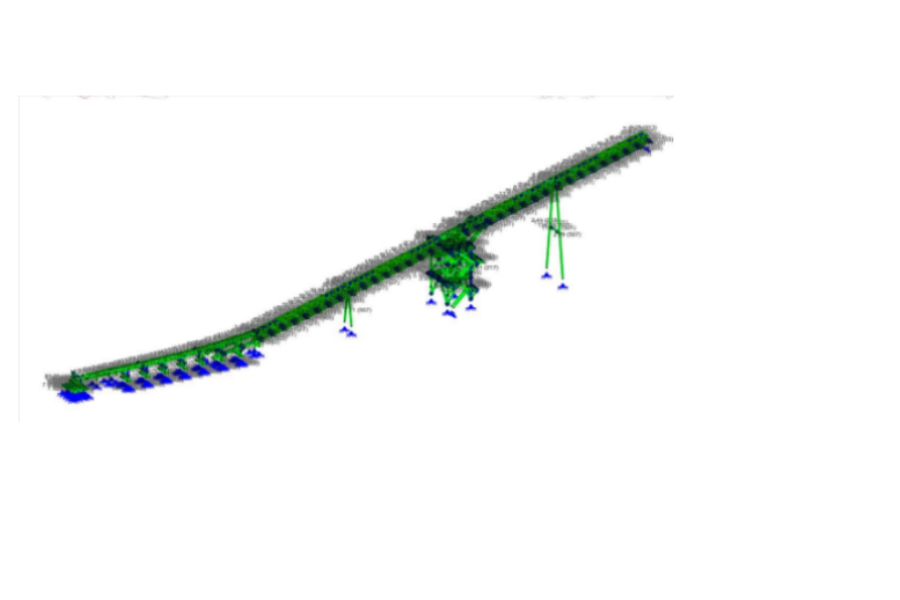
The materials handling system under review comprised an extensive array of interconnected structural elements: the overland coarse ore stockpile conveyor, stacker assembly, 20-metre spanning trusses, supporting trestles, take-up tower, stringers, tail frame, and discharge chute platforms. Each component required individual scrutiny within the context of the integrated system behaviour.
The proposed dome installation would change the loading profile affecting the materials handling infrastructure. Whilst the enclosure would beneficially reduce environmental wind exposure at the conveyor head end, it would simultaneously introduce new equipment loads from lighting arrays, control systems, and surveillance equipment. Furthermore, the client sought to validate a revised design throughput of 1,300 tonnes per hour; a substantial increase demanding comprehensive structural verification.
Compounding these challenges, the original materials handling steelwork predated significant updates to governing Australian Standards, necessitating a complete reassessment against current code requirements rather than simply verifying compliance with superseded provisions.
Sophisticated Analytical Methodology
Our engineering team deployed an advanced analytical approach centred on three-dimensional spatial modelling using SPACE GASS software, supplemented by rigorous manual calculations for critical verification. The methodology commenced with construction of a comprehensive digital model integrating the client’s 3D Navisworks geometry, site arrangement documentation, and belt profile data to accurately represent the complete materials handling assembly.
Load case development proved particularly crucial for this assessment. The analysis matrix encompassed static dead loads, operational live loads, both standard and flooded belt tension scenarios, material bulk loading, and multi-directional Ultimate Limit State wind actions calibrated to site-specific cyclonic conditions.
Where preliminary analysis identified potential overstress conditions under extreme wind events, our team applied refined higher-tier analysis methods incorporating detailed restraint evaluations. This sophisticated approach enabled accurate characterisation of actual structural behaviour, moving beyond conservative simplified assumptions that might otherwise trigger unnecessary remediation requirements.
Delivering Verified Performance and Commercial Value
The assessment concluded with comprehensive certification that the existing materials handling infrastructure fully satisfies current Australian Standards requirements, including AS/NZS 1170.0, AS/NZS 1170.1, AS/NZS 1170.2:2021, and AS 4100:2020. National Construction Code compliance was formally established for a 25-year structural design life.
Critically, the analysis verified that the complete materials handling system possesses adequate capacity to support the increased 1,300 tonnes per hour operational throughput alongside proposed head-end equipment additions. Serviceability assessments confirmed that operational deflections remain within permissible limits, whilst the proposed platform width expansion from 600 mm to 1,200 mm was validated as structurally viable.
The refined analytical approach delivered substantial commercial benefit beyond technical certification. By demonstrating that apparent wind-induced overstresses fell within acceptable design thresholds when properly analysed, our team eliminated the requirement for physical steel rectification works. This outcome preserved operational continuity, avoided costly structural modifications, and enabled the client to proceed confidently with their facility upgrade programme.
This project exemplifies the value of thorough, expert-led structural assessment in optimising materials handling infrastructure performance whilst ensuring ongoing regulatory compliance and operational safety.
Our engineering team delivers rigorous structural assessments that ensure compliance, maximise operational capacity, and protect your capital investment. Contact Yenem Engineering today to discuss your project requirements or download our capability statement for more information.
[/vc_column_text][/vc_column][/vc_row]


