Rethinking the Concept of a Site Inspections
The question itself is a paradox. Inspecting a site requires that the inspector is physically there, on-site. Doesn’t it? Traditionally, a site inspection has always meant boots on the ground, eyes scanning every corner, hands measuring, and the brain processing the environment in real-time. But what if there’s a better way? What if technology allows us to be virtually present without physically stepping foot on site?
As technology advances, people are discovering innovative solutions to traditional problems. From drones to 3D imaging, there are now methods to gather accurate, actionable information without the usual travel and logistics. Sometimes, these methods even surpass what you could accomplish in person.
COVID-19 as a Catalyst for Change
For all its challenges, COVID-19 has been a catalyst for positive change worldwide. Crises often force innovation, and those willing to adapt find opportunities. At Yenem Engineering, one such opportunity has been the evolution of off-site site inspections. Strict border closures in Australia meant that our usual inspection schedules were disrupted but this limitation forced us to explore alternative approaches.
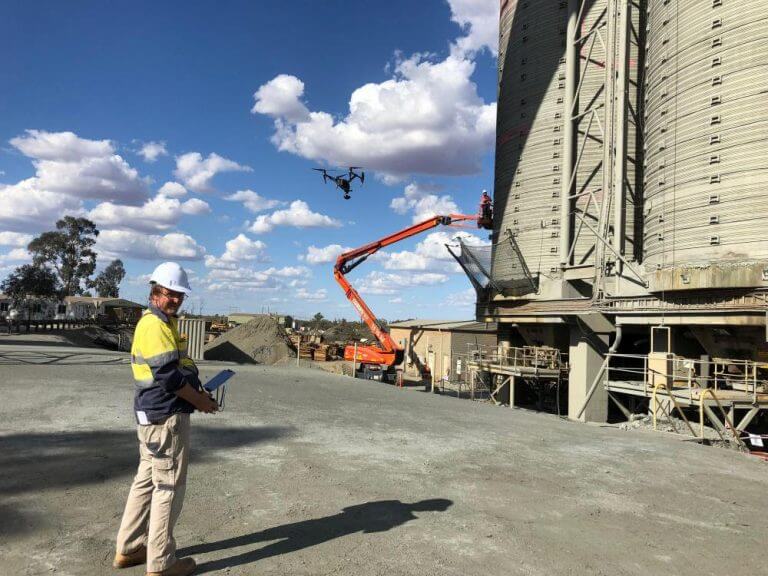
In April, we couldn’t attend our six-monthly inspection of concrete bins in outback New South Wales. Normally, this would have meant postponement or significant delays. However, our drone pilot and photographer, Brad, was already in the state. Equipped with our system for data collection, his drone became our eyes on site. Through high-resolution photographs and 3D imagery, our engineers could conduct a detailed analysis remotely, virtually walking the site without leaving the office.
Transforming Data into Insight
The remote site inspection process isn’t just about taking pictures. It’s about gathering actionable data that allows engineers and project managers to make informed decisions. In our workflow, images captured on-site are transformed into precise 3D models. These models, combined with measurements and documentation, form a virtual representation of the location. From this virtual environment, engineers can assess conditions, plan interventions, and even test design modifications before anything is physically implemented.
This approach has proven invaluable for projects where travel is difficult or impossible. By relying on technology, we can maintain the quality of our inspections without compromising on detail or accuracy.
Providing Remedial Solutions Remotely
One of our current projects involves significant remedial works at a mineral processing plant suffering from extensive corrosion. Traditionally, we would need to be on site to verify structural conditions and ensure designs were constructible. But with remote site inspections, the process has adapted.
We’ve been working with existing drawings, photographs, and measurements collected by on-site personnel. These inputs allow us to produce detailed structural design models and a complete CAD model (Navisworks) that fully documents the remedial works. Every bolt, beam, and panel is accounted for, and we can simulate construction scenarios to confirm feasibility—all without physically being on site.
Ensuring Accuracy and Constructibility
Accuracy is critical. Remote site inspections are only as effective as the methods and systems supporting them. That’s why we’ve developed a structured, systematic approach:
-
Data Collection: High-resolution photos, 3D scans, and measurements are captured on site.
-
Processing: Data is converted into detailed models and visualizations.
-
Analysis: Engineers review the models to detect potential issues, validate designs, and plan interventions.
-
Validation: Iterative checks ensure nothing is missed, and constructibility is confirmed before implementation.
Even though we would ideally want to be physically present, quarantine restrictions make it impractical. Instead, our system allows us to replicate the experience of being on-site while maintaining safety and efficiency.
The Team Behind Off-Site Site Inspections
Executing an effective remote site inspection requires a coordinated team. In our case:
-
Drone Pilot/Photographer: Captures accurate, high-quality imagery.
-
Photo Modeller: Converts photos into 3D models for detailed analysis.
-
Structural Engineer: Reviews the models and interprets the data to inform design decisions.
This triad ensures that all critical aspects of the inspection are addressed. The result is a virtual site experience that is both thorough and reliable.
Looking Ahead: A New Standard
Off-site site inspections are no longer a temporary workaround—they are a new standard for certain types of projects. While nothing can entirely replace the value of being physically present, remote inspections offer flexibility, safety, and efficiency that are hard to ignore.
A current project involves significant remedial works at a mineral processing plant that has suffered from major corrosion. Throughout the process, we’ve worked with existing drawings, photographs and measurements fed from people on site to produce structural design models and a CAD model (Navisworks) to fully document the remedial works.
We want to ensure our designs are constructible. We want to make sure we haven’t missed anything. We really need to go to site. But we can’t. At least not without two lots of 14-day self-quarantine.
So we’re doing it again.
We have our drone pilot/photographer, our photo modeller, and our structural engineer, poised to perform an offsite site inspection using our systemised method I’m calling… Well, I’m kinda stuck on a name.
Hit Reply and let me know what you think.
Unlock Your Site’s Potential – Book a Free Consultation Today!
Curious how a remote or on-site site inspection can save time, reduce costs, and ensure accuracy? Our experts are ready to walk you through the process and answer all your questions. Schedule your free consultation now and see how we can bring precision and insight to your next project.