Virtual Reality in the Mining Industry: Unlocking New Possibilities

Yenem Engineering Services

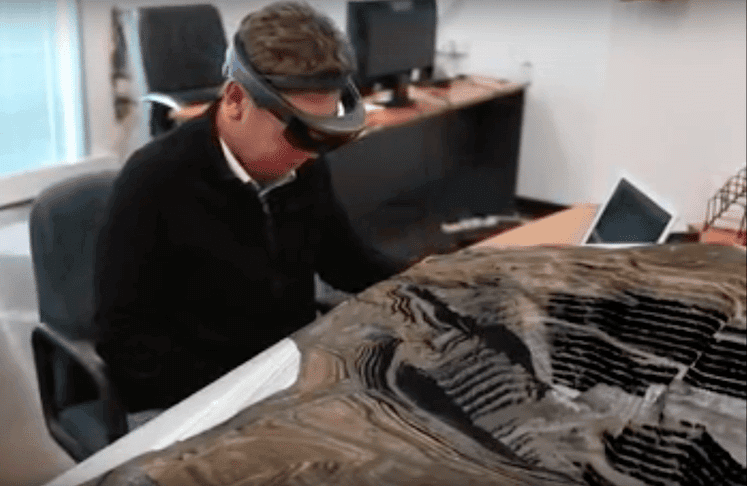
Man using VR headset to view a 3D model of a mine, showcasing virtual reality in the mining industry.

Reading Time: 4 minutes

Virtual Reality in the Mining Industry: Unlocking New Possibilities

Virtual Reality in the Mining Industry: How Engineering Innovation Is Reshaping the Future

It is no exaggeration to say that technology has taken a giant leap forward over the last decade. In just a few short years, the way we live, work, and interact with the world has fundamentally changed.

Ride sharing platforms like Uber transformed the taxi industry almost overnight. The rollout of 4G networks delivered fast, mobile internet to millions. Messaging and social media platforms such as WhatsApp and Instagram reshaped communication, marketing, and even global culture.

So who do we thank for these massive shifts in daily life? Engineers, without a doubt.

But as impressive as these advancements are, the most exciting question is still ahead of us. What’s next? Artificial intelligence and self driving cars dominate headlines, but there are other powerful innovations quietly gaining momentum. One of the most promising, and most underrated, is Virtual Reality in the Mining Industry.

The Arrival of 5G and a New Era of Possibility

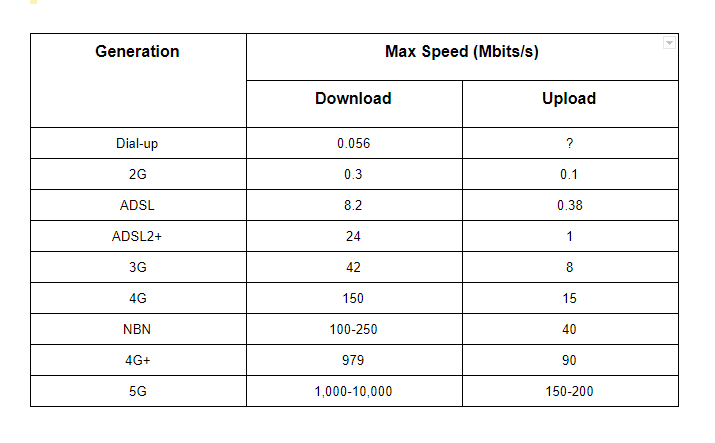
As 5G networks roll out globally, we are entering a new phase of technological capability. Faster speeds, lower latency, and increased data capacity will redefine how both humans and machines operate. For industries that rely on real time data, automation, and remote operations, 5G is a game changer.

Mining is one of those industries.

The speed and reliability of 5G enable real time simulations, remote collaboration, and immersive digital environments. This makes Virtual Reality in the Mining Industry not just viable, but truly transformative. With faster data transfer, virtual and augmented reality tools can finally operate at the scale and fidelity required for heavy industry.

This is where engineering, connectivity, and immersive technology come together.
Virtual reality in mining
Generations of Internet and their speeds

Understanding Virtual, Augmented, and Mixed Reality

Before diving deeper into Virtual Reality in the Mining Industry, it helps to understand the differences between the key immersive technologies.

Virtual Reality (VR) is a fully computer generated environment. Users are completely immersed in a simulated world, often through a headset. Think advanced training environments, flight simulators, or virtual mine sites that replicate real world conditions.

Augmented Reality (AR) overlays digital information onto the real world. Engineers can view geological data, equipment specifications, or structural elements superimposed onto a physical environment.

Mixed Reality (MR) blends both worlds. Digital objects are anchored to real world locations and interact with them. Devices such as Microsoft’s HoloLens allow engineers to walk through physical spaces while seeing virtual infrastructure, designs, or data layered precisely where it belongs.

Together, these technologies form the backbone of Virtual Reality in the Mining Industry.
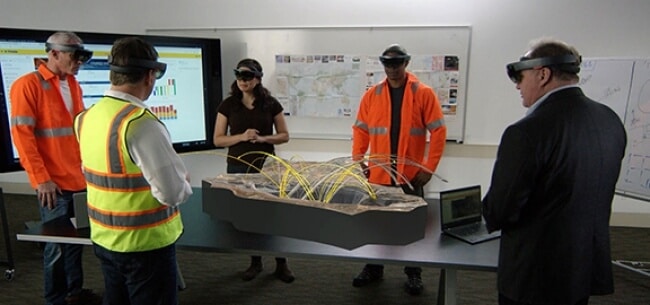
Virtual reality in mining
Using augmented reality to process mining data

Virtual Reality in the Mining Industry: Real World Applications

Mining operations are complex, hazardous, and data intensive. This makes them ideal candidates for VR, AR, and MR solutions.

One of the most impactful uses of Virtual Reality in the Mining Industry is training and safety. New workers can be immersed in realistic mine environments without exposure to danger. Emergency scenarios such as equipment failures, collapses, or evacuations can be simulated repeatedly until responses become second nature.

Another powerful application is mine planning and design. Engineers can walk through a virtual mine before a single piece of equipment is deployed. Tunnel layouts, ventilation systems, and haul routes can be reviewed collaboratively, reducing costly design errors and improving operational efficiency.

Remote operations and inspections are also being transformed. Using mixed reality, engineers can inspect infrastructure while viewing original design models superimposed over existing structures. Missing supports, misaligned components, or structural risks become immediately visible, long before they turn into safety incidents.

Data Visualisation and Better Decision Making

Mining generates enormous volumes of data, from geological surveys to real time equipment telemetry. Traditionally, this data has lived on screens, spreadsheets, and dashboards. Virtual Reality in the Mining Industry changes this by turning data into an immersive experience.

Instead of interpreting flat charts, engineers can step inside three dimensional geological models, explore ore bodies spatially, and visualise stress points or material flows in real time. This deeper understanding supports better decisions, faster problem solving, and stronger collaboration across teams.

Augmented reality can also assist on site workers by displaying live data directly in their field of view. Equipment performance, maintenance instructions, and safety alerts can be accessed without stopping work or consulting manuals

Smart Infrastructure and the Future of Mining

As 5G enables smarter, more connected infrastructure, the mining sector will benefit from increased automation and data integration. Autonomous vehicles, sensor networks, and AI driven systems will increasingly connect with Virtual Reality in the Mining Industry, creating digital twins of entire mining operations.

These digital twins allow companies to test changes virtually before implementing them in the real world. The result is reduced downtime, improved sustainability outcomes, and lower operational risk.

Looking Ahead

The future of mining will be safer, more efficient, and more collaborative, with immersive technology playing a central role. Virtual Reality in the Mining Industry is no longer a futuristic concept. It is a practical tool already delivering measurable value today.

As 5G technology matures and hardware becomes more accessible, the line between physical and digital mine sites will continue to blur. Engineers will not just design, inspect, and operate mines. They will experience them in entirely new ways.

So the real question is this. How do you want Virtual Reality in the Mining Industry to work for you?

What problems would you like VR, AR, or MR to solve? What opportunities are you already exploring in the immersive technology space?

Let’s have a chat.

Share This
Related Posts